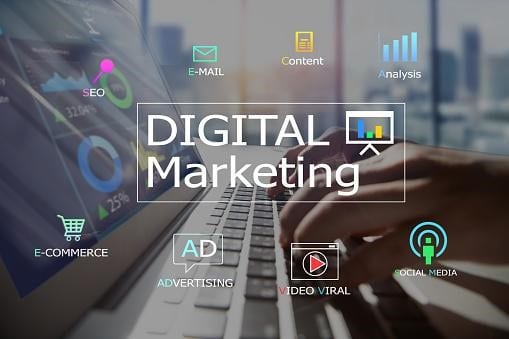
Top Digital Marketing Trends Using AI

Digital marketing has crossed a real inflection point. AI is no longer a “nice to have” bolted onto a campaign — it now shapes how content gets discovered, how customers are targeted, and even how search itself works. Marketers who understand where AI is actually moving the needle (and where it’s just hype) are the ones pulling ahead. Here are the trends defining the space right now.
1. Generative Engine Optimization (GEO)
Traditional SEO isn’t dead, but it’s no longer enough on its own. A growing share of searches are now answered directly inside AI chat tools and AI-generated summaries, before a user ever clicks through to a website. That means brands need to optimize not just for search engine rankings, but for being cited by AI systems — think structured data, clear entity definitions, and authoritative, well-organized content that a language model can easily parse and reference.
What this means in practice:
- Build interconnected content clusters instead of isolated blog posts, so AI systems recognize topical authority.
- Use clean structured data (schema markup) so AI tools can accurately extract facts about your brand.
- Write in a clear, question-and-answer style that mirrors how people actually query AI assistants.
2. AI-Powered Hyper-Personalization
Generic email blasts and one-size-fits-all landing pages are increasingly ineffective. AI now allows marketers to tailor messaging, offers, and even entire customer journeys in real time, based on behavior, purchase history, and predictive modeling — at a scale no human team could manage manually.
What this means in practice:
- Predictive analytics can flag which customers are close to churning or ready to buy.
- Dynamic website content and email copy can shift automatically based on user segment.
- Personalization needs to be balanced with privacy — see trend #5 below.
3. Conversational AI and Chatbots as a Conversion Channel
AI chatbots have moved well past clunky FAQ bots. Modern conversational AI can handle real-time product questions, guide customers through decisions, and close sales — and websites without this kind of real-time interaction risk losing conversions to competitors who offer it.
What this means in practice:
- Conversational AI tools are becoming a core part of the sales funnel, not just customer support.
- Voice and chat-based shopping assistants are increasingly expected on e-commerce sites.
4. AI-Driven Content Creation at Scale
Generative AI tools are now deeply embedded in content workflows — drafting copy, generating product descriptions, producing video scripts, and even assisting with AR/VR experiences. The trend isn’t just “more content faster,” though; it’s a growing emphasis on pairing AI efficiency with genuine authenticity, since audiences and algorithms alike are increasingly sensitive to generic, obviously AI-generated material.
What this means in practice:
- Use AI to speed up drafts and ideation, but keep human editing and brand voice central.
- Authentic, people-first content is becoming a differentiator precisely because so much AI content looks the same.
5. Privacy-First, First-Party Data Strategies
As third-party cookies fade and privacy regulations tighten, brands are shifting hard toward first-party data — information customers willingly share directly with a brand. AI helps make sense of this data at scale, but the underlying strategy is about earning trust, not just collecting more data points.
What this means in practice:
- Loyalty programs, gated content, and direct customer relationships are valuable first-party data sources.
- Brands that build these “owned” data ecosystems tend to see stronger retention and engagement over time.
6. Predictive Analytics for Smarter Targeting
AI-driven predictive analytics now allow marketers to anticipate customer needs — what someone is likely to buy next, when they’re likely to churn, or which channel will convert them — rather than just reacting to past behavior.
What this means in practice:
- Marketing spend can be allocated toward the customers and channels most likely to convert.
- Campaign timing and messaging can be optimized proactively instead of through trial and error.
7. Social Commerce and AI-Optimized Short-Form Video
Short-form video and in-feed shopping continue to dominate attention, and AI is increasingly used to identify trending formats, optimize posting times, and even assist with editing. Social platforms are becoming full-fledged sales channels rather than just awareness tools.
What this means in practice:
- Social commerce features (in-app checkout, shoppable video) are growing fast.
- AI tools can help identify which content formats and hooks are resonating in real time.
A Word of Caution: AI Isn’t Infallible
It’s worth remembering that AI-driven automation still requires human oversight. There have been real cases of AI mis-scheduling global campaigns because it lacked awareness of local cultural context — a reminder that AI is a powerful tool for scale and efficiency, but human judgment remains essential for nuance, timing, and cultural sensitivity.
The Bottom Line
The through-line across all of these trends is the same: AI is reshaping where and how customers discover brands, not just how efficiently marketing teams operate. Winning in this environment means combining AI’s speed and scale with authentic content, first-party trust, and a willingness to keep a human hand on the wheel.
Whatever maybe your business, irrespective of the products or services, you cannot ignore digital marketing. Artificial intelligence, voice search, content marketing, and chatbots are some of the trends that are already dominating the digital marketing landscape. The trends are evolving so rapidly that it is difficult to keep up with them. Hence, it is forcing businesses to adopt new digital marketing strategies to stay ahead in the game.
In this article, let us look at the top trends that would shape the digital marketing landscape.
No Click Searches
If you notice Google search results, you would see that your answer comes in a paragraph and relevant information in a box at the top of the page. This is known as the Position Zero on the results page. No click searches allow customers to get their answers without visiting any webpage. As digital marketers, you have to ensure that the content is engaging enough so that your potential customers click on your website and visit the webpage.
Virtual and Augmented Reality
According to Gartner, almost every business in the world would resort to some immersive technology to increase sales and provide more value to its customers. Augmented reality allows customers to have a visual impact on their purchase, reducing the time taken for closing deals. Virtual reality is another immersive technology that gives a completely simulated experience to the buyers. Experts have predicted that the spend on technologies and services that enable digital transformation could touch $1.97 trillion in the next 2 years.
In 2020, businesses and brands would be increasingly using these AR / VR technologies for driving their sales.

Google Business Listing
If you have geographically localized businesses like plumbing, salon business, and likewise, then you should get your business listed on Google. This would help you gain visibility during the near me searches. Your customers can learn about your service, your working hours, rates, and ratings. Google My Business Listings would help you manage your business online (on maps and searches) and improve the credibility of your business against unverified competitors.
Social Commerce
Social media has helped the eCommerce industry to flourish in the last decade. Facebook, Instagram, Twitter, and every other social media platform have become the best friends for businesses and brands across the world. They are leveraging social commerce to gain visibility, build credibility, and sell their products. The majority of the customers use social media for information search, and hence, social commerce would continue to dominate digital marketing in 2020.
Smart Bidding
To get the maximum from Google-Ads, you need to adjust and modify your bids frequently. But it is challenging owing to the huge volume of online data. In 2020, we see that smart bidding has become the norm. Machine learning is being used to analyze the large chunks of data and automatically adjust the bids to get maximum conversions. This is great news for the ad campaign and PPC managers.
Conclusion
To be at the top of the digital marketing game seems overwhelming, but if businesses capture these trends and work on them, they would surely stay ahead of their competitors.
[custom-twitter-feeds feed=2]