
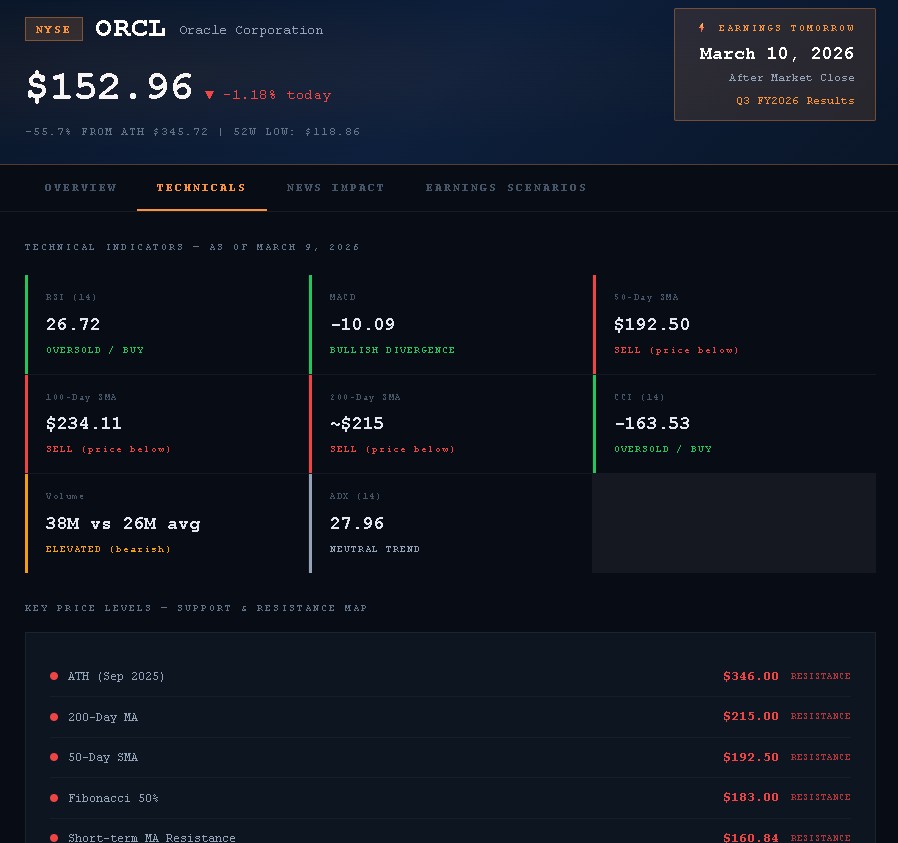
Oracle Corporation (ORCL) (Oracle Earning) will release its fiscal third-quarter earnings late Tuesday, following a difficult stretch in which investor concerns about the company’s expensive artificial-intelligence investments have pressured the stock for almost six months.
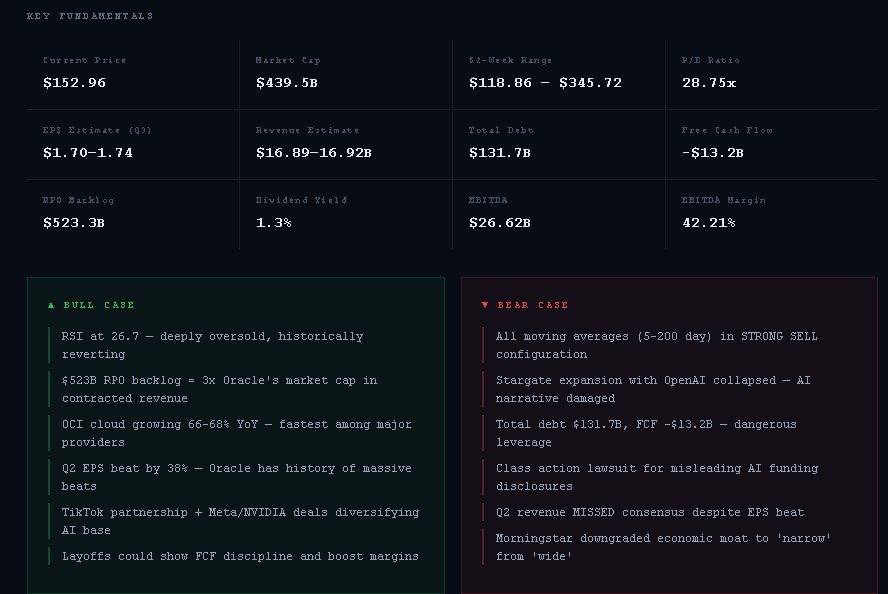
Since September, Oracle has been at the center of the broader debate around AI infrastructure spending. The enterprise technology company drew major attention after revealing that its remaining performance obligations (RPO) surged by triple digits, reaching a $455 billion backlog, driven largely by strong demand for its cloud services. That announcement initially sparked a huge rally, sending Oracle’s shares up more than 30% in a single trading day. However, the stock has since retreated as investors reassessed the risks and costs tied to the company’s aggressive AI expansion.
Current State: A day before Oracle Earning, ORCL is trading at $152.96, within a 52-week range of $118.86 to $345.72 Investing.com — meaning it’s sitting roughly in the middle, but down ~50% from its all-time high, with the stock approaching its 200-week moving average TradingView.
Technical Picture: ORCL’s RSI (14) is 26.72 (deeply oversold/buy signal), MACD is -10.09 (bullish divergence), but the 50-day SMA is $192.50 and 100-day SMA is $234.11 — both well above price, confirming a sell trend TipRanks. Across all timeframes from 1-minute to monthly, the signal is Strong Sell based on moving averages Investing.com.
What the Street Expects: Analysts project adjusted EPS of $1.71 (up 16.3% YoY) and revenue near $16.92B (~20% growth) Blockonomi. Oracle’s RPO backlog reached $523.3B, up 433% YoY, driven by Meta and NVIDIA contracts TradingView.
Key News Risks:
- Oracle and OpenAI scrapped plans to expand the Stargate datacenter in Abilene, TX after financing negotiations stalled — Meta/Nvidia are now stepping in Bloomberg
- Oracle is planning to cut thousands of jobs across divisions to handle a cash crunch from its AI datacenter expansion Bloomberg, with reports of up to 30,000 roles affected
- A bondholder class action lawsuit alleges Oracle misled investors about AI expansion funding requirements after issuing $18B in bonds post-OpenAI deal FX Leaders
1. Current Snapshot
-
Current price: ~$153
-
Market cap: ~$574B
-
P/E ratio: ~37
-
EPS (TTM): ~$5.32
Interpretation:
-
High valuation relative to legacy software companies.
-
Investors are pricing AI + cloud growth into the stock.
2. Technical Analysis Trend
-
Short term (1–3 months): Downtrend → Base forming
-
Price fell from ~$200+ peak in 2025 to ~$150.
This is a large correction phase (~25–30%).
Key Support Levels
Major demand zones:
-
$148–150 → strong short-term support
-
$140 → major technical support
-
$130 → extreme downside level
Break of $148 could trigger algorithmic selling.
Key Resistance Levels
-
$160 → first resistance
-
$172–175 → strong resistance
-
$185+ → breakout zone
If earnings are strong, price will target $170 area quickly.
Moving Averages
Estimated levels:
| Indicator | Level | Signal |
|---|---|---|
| 20-day MA | ~$152 | neutral |
| 50-day MA | ~$160 | bearish |
| 200-day MA | ~$175 | bearish |
Interpretation:
-
Below long-term trend → bearish bias
-
But near short-term support → bounce potential
RSI (Relative Strength Index)
Estimated:
RSI ≈ 40–45
Meaning:
-
Near oversold
-
Not extreme yet
-
Room for earnings bounce
Volume Analysis
Recent characteristics:
-
Heavy selling during decline
-
Stabilizing volume last weeks
Interpretation:
-
Institutional selling slowing
-
Accumulation may start if earnings beat.
3. Options Market Expectation
Typical expected earnings move for ORCL:
±7–9%
So traders expect post-earnings range roughly:
$140 → $165
4. Key Fundamental Catalysts
1. AI Infrastructure Demand
Oracle is benefiting from AI compute demand because its cloud is optimized for GPUs.
Major customers include:
-
AI startups
-
enterprise AI deployments
If management reports AI capacity demand surge, stock likely rallies.
2. Cloud Growth
Oracle Cloud Infrastructure (OCI) is the main growth engine.
Investors watch:
-
Cloud revenue growth %
-
backlog of AI data center deals
If cloud growth > 30% → bullish.
3. Nvidia / AI Data Center Partnerships
Oracle builds GPU clusters used for AI workloads.
High demand from AI companies can push revenue higher.
4. Competition Risk
Oracle competes with:
-
Amazon (AWS)
-
Microsoft (Azure)
-
Google (Cloud)
If growth slows vs these competitors → bearish reaction.
5. Analyst Expectations
Typical expectations for upcoming earnings:
Revenue:
~$13–14B
EPS estimate:
~$1.45–1.55
Key metric:
Cloud revenue growth
6. Sentiment Analysis
Market sentiment is currently mixed-bullish.
Bullish factors:
-
AI demand
-
OCI growth
-
enterprise database dominance
Bearish factors:
-
high valuation
-
slowing tech sector
-
prior stock correction
7. Historical Earnings Reaction
Typical Oracle earnings moves:
| Earnings | Price Move |
|---|---|
| Beat + strong guidance | +10–15% |
| Beat but weak guidance | +3–6% |
| Inline | −3% |
| Miss | −8–12% |
8. My Probabilistic Price Projection
Based on:
-
support levels
-
valuation
-
expected move
-
sentiment
Bullish Scenario (35%)
Strong AI cloud demand
Price after earnings:
$165–175
Neutral Scenario (40%)
Inline earnings
Price:
$148–158
Bearish Scenario (25%)
Weak guidance or cloud slowdown
Price:
$135–145
9. Most Likely Post-Earnings Price
The stock has already priced in enormous negatives. With RSI at 26.7 and a history of massive EPS beats (last quarter Oracle beat EPS estimates by 50.67%, posting $2.26 vs $1.50 expected Public), a clean beat on cloud metrics could spark a relief rally.
My base-case estimate:
≈ $160
Reasoning:
-
Oversold technical condition
-
AI demand narrative still strong
-
support near $150 holding
Estimated move:
+4% to +6%
[custom-twitter-feeds feed=2]